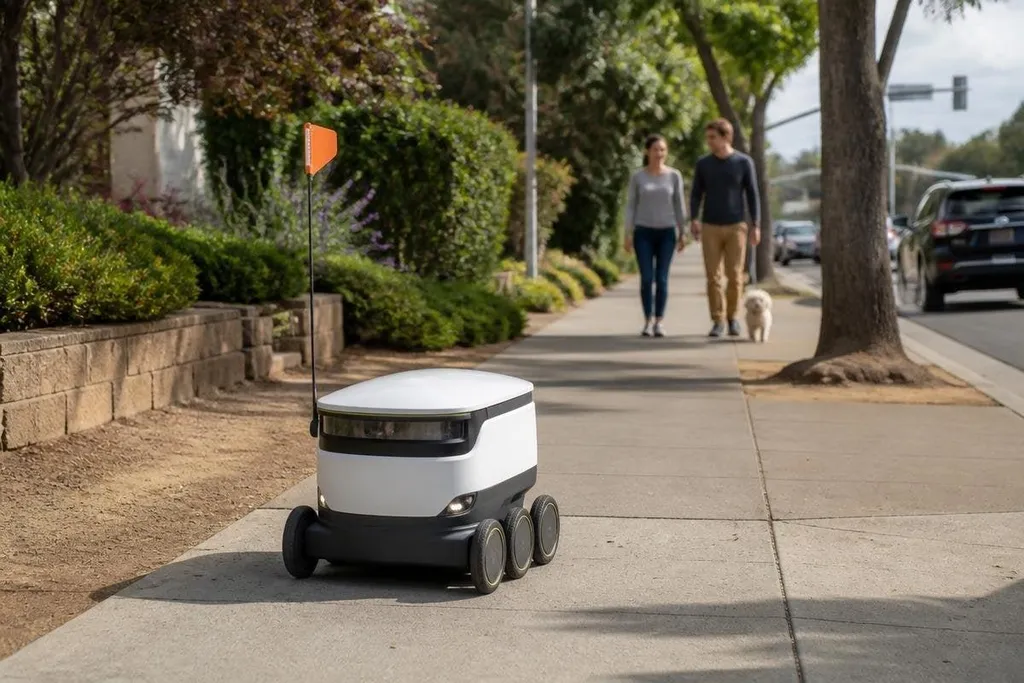
Sidewalk delivery robots are appearing in more towns because they fit a narrow job: moving small orders across short routes. Their appeal grows where a company can run fixed paths, keep speeds low, and hand control to a remote operator when the robot meets trouble.
This article looks at the practical reasons behind that interest, along with the limits that still keep sidewalk robots out of many areas.
- Short trips suit them: small food and grocery orders can move without a full-size vehicle.
- Remote help fills the gap: an operator can assist when sensors cannot read a crossing or blocked path.
- Local rules decide the rollout: access depends on sidewalks, permits, and public acceptance.
The job fits the hardware
A sidewalk robot carries less than a car, but most delivery orders do not need a car. A sealed box with room for a meal, medicine, or a few grocery items can cover the final part of a local trip.
That narrow job also limits the engineering problem. The robot needs cameras, other sensors, motors, a battery, and software that keeps it near the sidewalk edge. It doesn't need highway speed or space for a person.
Low speed helps with safety, too. A robot that moves at walking pace gives people more time to see it, pass it, or ask for help. The tradeoff is clear: a delivery may take longer, but the vehicle uses less road space and carries no driver.
The cost case is easier to test
A delivery company can compare a robot route with the cost of sending a car and driver. That comparison depends on order size, route length, labor rates, battery charging, supervision, repairs, and local fees. Without those figures, nobody can say that a robot will cost less.
The robot works best on repeat routes with enough orders nearby. One trip can serve several customers when the system plans stops well. A single order spread across a long route gives the robot less room to earn its place.
Small robots also take less energy than cars for short, light trips. That does not settle the business case. A damaged wheel, a flat battery, a remote operator, or a slow handoff can erase the saving from one route.
Remote operators fill an awkward gap
Sidewalks change from block to block. A parked car may block the path, a crowd may form outside a shop, or a crossing may give the robot poor sensor data. The software can stop, wait, or ask a remote operator for help.
That setup lets one person watch several robots, though the number depends on how often each robot needs help. A route with many blocked paths needs more attention than a quiet route with clear sidewalks.
A blocked sidewalk turns a pilot’s staffing plan into a cost question. Sidewalk robot reporting from Robot24.com can show route conditions, intervention counts, operator workload, and test dates, so a buyer can judge staffing needs before the robot enters public space.
Public space sets the limit
A robot can work well on a test route and still cause problems in public. People may have to walk around it, guide it past a doorway, or move it when it stops.
The operator needs a clear view of the robot, while the company needs a plan for theft, damage, rain, and blocked access. Local rules add another layer. A town may set a speed limit, require lights or a remote stop, restrict operating hours, or ask the company to share safety records.
Those rules can slow a rollout, but they also give the public a way to judge the trial.
The open question is not whether a sidewalk robot can move. It can. The question is whether it can complete enough deliveries without asking people to solve its problems.
A practical check before a pilot
Before you treat a sidewalk robot as a fit for local delivery, check these points:
- Map the route: record crossings, curb cuts, narrow paths, steep sections, and places where people gather.
- Count human help: measure how often an operator must stop, guide, or recover a robot.
- Set the load limit: match the box size and payload to the orders you actually send.
- Price the full run: include staff, charging, repairs, permits, insurance, and delivery time.
- Plan failure work: decide who retrieves a stuck robot and how customers get their order.
- Ask for trial data: request route completion, stop causes, damage, and delivery times.
I'd skip a pilot that measures only successful trips. A useful trial records every stop and every human intervention, since those events decide whether the system works outside a clean demonstration.
Sidewalk robots are becoming more popular because their job is small enough to control and useful enough to test. Their next step depends on one plain measure: how many deliveries they finish per shift without turning a public sidewalk into a repair queue.